
Children’s Book Illustrator: Mastering the Art of the Children’s Book Inside My Studio
Drawing about kids is just not about looking cute; it’s about building a world that feels real enough to jump into. After 15+ years of spending in this field, I have found that being a professional children’s book illustrator is a mix of wild imagination and strict discipline. To get a book from a blank screen to a child’s hand, you need more than just a talent. You need a rock-solid process, strong imagination, and dedication.
Start with a spark
Everything starts with a rough idea. If you look at the photo I provided, you can see there are some rough outlines. You can also see just a pencil sketch of a koala.
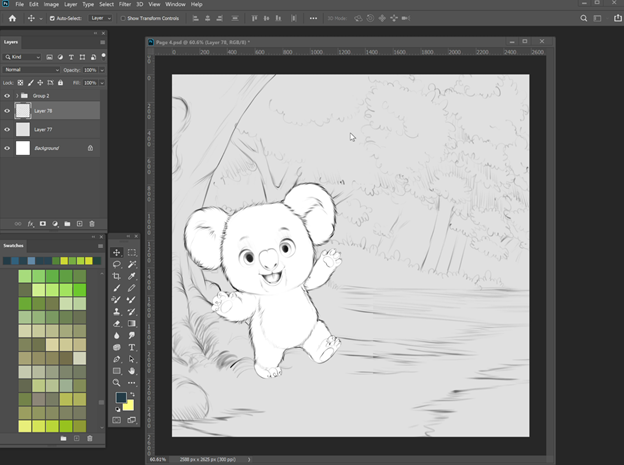
At this stage, I don’t care about grass, jungle, trees, or anything else. I only care about the koala’s expression. Does he look happy? Is his expression enough to attract children? I think, or I believe, any professional children’s book illustrator knows that if somehow a character’s expression or acting sketch goes bad at this point, no color or nothing could save it later. I always keep the background lighting loose so that a child or anyone can focus directly on my character.
The gritty middle- structure and color
Once the character is set. I started building an environment or background. This is where many artists get overwhelmed, but my 15+ years of experience have taught me to stay organized. In the image below, you can see my Photoshop workspace.
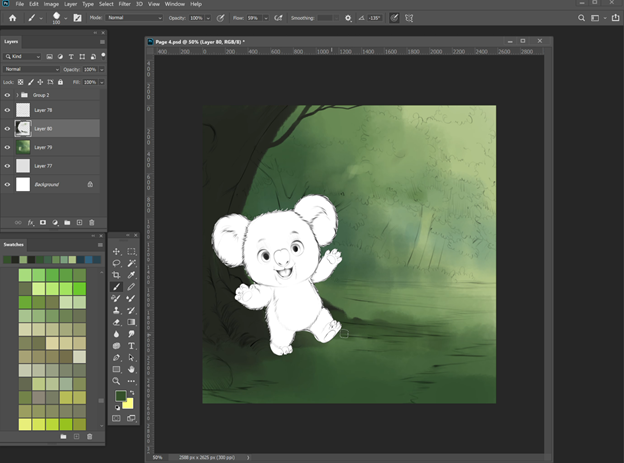
Notice the “layers” and “swatches” panels on the side. Keep everything labeled and tidy.
Why? Because punctuality matters. If a publisher calls me and wants to change the shade of green on a tree, I shouldn’t have to spend three hours hunting for the right layer. Being professional means being fast and efficient, so the book stays on schedule.
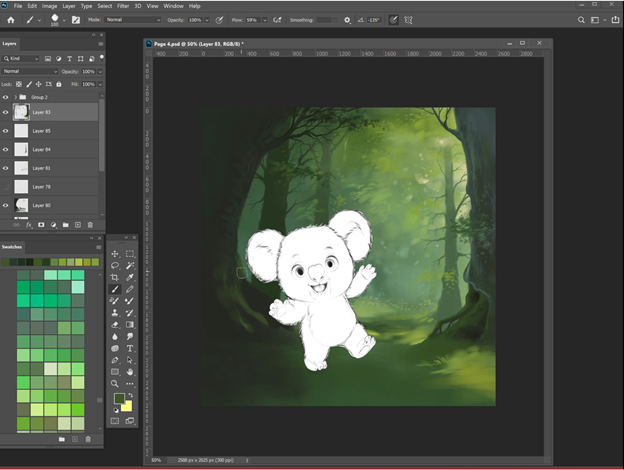
In the image given below, I move away from the lines and start “blocking in” the deep mossy greens. I want the forest to feel thick and old, setting the stage for the light to come.
Bringing magic to life
The real fun begins when the light hits the canvas. In the image I gave below, I start painting the atmosphere.
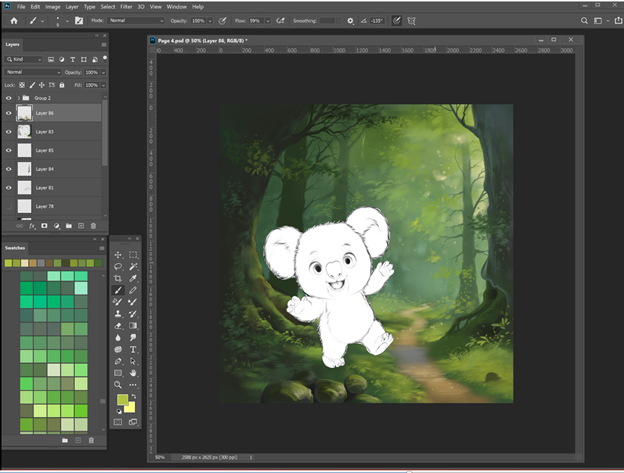
I am thinking about how the sun filters through the canopy and hits the dirt path. The depth gives the book a high-quality feel.
This lightning is designed to enhance the emotion of the story, the excitement in Koala’s eyes, supported by the bright light. In this process, you may notice some of the trees in the back have disappeared, and you also notice that some new jungle has grown. New shadows were added. The pathway moved several times.
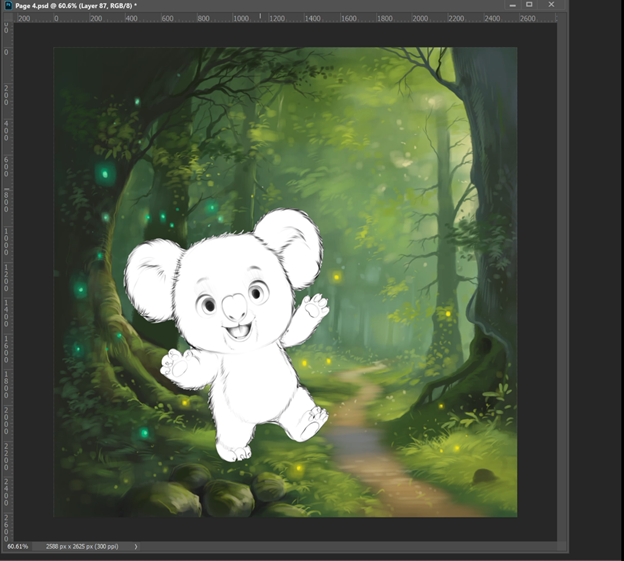
In this stage, the background looked more polished. I added a tiny highlight to Koala’s eyes and those glowing, magical fireflies that float in the shadows. You may have noticed that at first, the ground looked empty and flat. Later, I added moss textures, darker corners, and a winding pathway to create movement.
These details may seem small, but they quietly guide the reader through the page.

What makes an illustration feel memorable
I always believed that children remember feelings more than technical details.
They may forget how a tree was painted, but they remember how an illustration made them feel.
That is why I focus on atmosphere while creating children’s book illustrations.
I want children to pause on a page and imagine themselves inside that world.
In the above image, the Koala may be beginning a new adventure, but I want children to remember him for his soft, textured fur, bright, excited eyes, and happy face.
Final thoughts
At the end of the day, my job is to be a reliable partner for authors or publishers. They know that when they work with Ananta Moahanta, they are getting someone who values quality, respects clocks, and brings over a decade of expertise to every single stroke of the brush.
To know more: www.anantamohanta.com
Pinterest: https://in.pinterest.com/illustratorananta/
X: https://x.com/AnantaMohanta6
Behance: https://www.behance.net/ananta-mohanta
Follow me on Instagram: www.instagram.com/ananta_mohanta_